


Supportive Orthopedic Shoes for Women: All-Day Comfort
Orthopedic Shoes for Women: How to Choose Supportive Footwear for All-Day Comfort
You love your favorite office flats, but by 3:00 PM, your arches feel like they are collapsing. For decades, curing this daily fatigue meant surrendering to clunky, heavy medical boots. Forget that outdated stigma. Modern orthopedic shoes for women hide their science inside gorgeous silhouettes, ensuring you never have to choose between looking professional and walking without a limp.
According to podiatry experts, roughly 75 percent of women will experience foot issues, yet many ignore the root cause. Think of your body like a house where your feet act as the basement. Just like a tilted foundation eventually cracks the walls above, poor alignment shifts your joints, triggering a painful chain reaction. This structural imbalance directly explains the surprising impact of footwear on lower back pain and aching knees.
Proper alignment actually does much more than simply prevent blisters; it stabilizes your entire skeleton from the ground up. Finding the right supportive shoes for women transforms how your body absorbs daily shock, replacing afternoon fatigue with all-day energy and newfound confidence in your stride.
Soft Isn't Always Supportive: Using the 'Mattress Test'
Sinking into a memory foam shoe feels heavenly initially, but eventually leaves your feet aching. Think of it like a mattress: an overly soft bed feels cozy, but without a firm core, your back suffers. Basic comfort shoes rely on squishy padding, forcing your foot muscles to work overtime just to keep you balanced.
To spot the difference between a trendy sneaker and true orthopedic shoes for women, try the "Torsion Test." Grab the toe and heel, twisting them in opposite directions. Proper footwear features torsion control—a rigid mid-section that resists twisting to stabilize your stride. If the shoe wrings out easily like a wet rag, it cannot safely support your joints.
The best orthopedic footwear for ladies goes beyond simple foam by satisfying The Big Three Checklist:
-
Firm Heel Counter: A rigid back cup acting as a stabilizing kickstand for your ankle.
-
Anatomical Arch Support: A structured inner curve built to prevent ligaments from overstretching.
-
Wide Toe Box: Extra upfront space allowing your toes to spread naturally without pinching.
Investing in medicated shoes for ladies means prioritizing this hidden stability over pillowy fluff.
The Wet Paper Towel Test: Discover Your Foot Shape
Before mastering how to choose supportive footwear, you must understand your unique foundation. You can easily identify this at home using the wet paper towel test. Just step out of the shower with damp feet and stand naturally on a piece of heavy paper. Look down at the shape left behind.
Compare your footprint to these three distinct profiles:
-
Flat Feet (Pes Planus): Seeing almost your entire footprint means your foot rolls inward. Check out our curated collection of shoes for flat feet pes planus built with firm internal lifts.
-
High Arches (Pes Cavus): Seeing only your heel and the ball of your foot indicates a rigid bridge. You’ll need specialized high arch pes cavus footwear that provides extra shock absorption.
-
Neutral Arch: Seeing a moderate inner curve means your foot balances naturally but still requires a structured base.
Correct Your Foundation: Stability vs. Motion Control
Your footprint predicts exactly how your foot moves. If your test showed a wide imprint, your arches likely collapse inward (overpronation). Conversely, high arches often lead to supination, rolling your weight onto the outer edges of your feet.
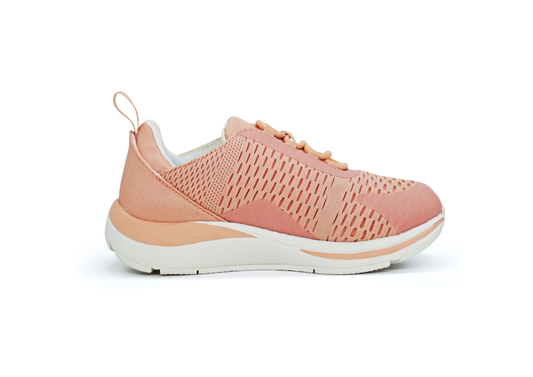
When correcting overpronation, look for a "medial post"—a dense piece of foam on the inner edge that acts like a bicycle kickstand. This prevents unnatural twisting from traveling upward to your knees and hips. For active days, the Sprinter Orthopedic Athletic Shoe in Rose provides this essential "Kickstand Effect" without looking like a medical device.
Healing the 'Bowstring': Solutions for Plantar Fasciitis
Waking up to sharp heel pain is a classic sign your plantar fascia—the thick tissue under your foot—is strained. Think of this tissue like a tight bowstring; without support, the string overstretches.
Finding the best walking shoes for plantar fasciitis means looking for a slight heel elevation. This subtle lift provides slack to the bowstring, allowing the inflamed ligament to heal naturally. For those needing localized relief at the ball of the foot, look for:
-
Rocker Soles: Curved bottoms that roll your foot forward.
-
Deep Heel Cups: Cradles the heel’s fat pad for shock absorption.
-
Metatarsal Pads: Targeted cushions supporting the bones behind your toes.
From Boardroom to Boardwalk: Style Meets Science
The secret to surviving office hours lies in finding stylish flats with arch support. Today, you can find pursuit womens slip on orthopedic shoes that beautifully mask their orthopedic foundations.
For more casual settings or running errands, the Chippy comfort orthopedic walking shoes for women offer high-performance alignment that blends seamlessly with jeans. Even at home, you shouldn't neglect support; slipping into breezy slipper footwear for women ensures your recovery continues even while you lounge.
Top Recommendations for Women:
| Need | Recommended Style |
| All-Day Walking | Balance Running Shoes Womens |
| Warm Weather Support | Sawyer Womens Orthopedic Sandal |
| Dressy Comfort | Buttercup Orthopedic Sandal Women |
| Relaxation | Slipper Rose Women |
Orthopedic Footwear Q&A
Q: Do I need a doctor’s prescription to buy these? A: Not always. Most therapeutic shoes are designed for common needs like mild overpronation or daily fatigue. However, if you have diabetes, consult a pro and look into specialized diabetic footwear.
Q: Can I wear my own orthotics in these shoes? A: Yes! Look for styles with removable footbeds. Simply pull out the factory cushion to make room for your custom mold.
Q: How long does it take to break them in? A: Your muscles may need time to adjust to corrected alignment. A gradual ramp-up over about a week is common.
Your 7-Day Transition Plan
To transition safely to a pain-free lifestyle, use The New Shoe Success Checklist:
-
2-hour daily limit initially to let your muscles gently adapt.
-
Sock thickness check using the exact socks you wear daily.
-
The 'Finger-Width' toe gap test to ensure perfect spacing.
By respecting this slow integration period, you are building a comfortable foundation. Step forward with true confidence, knowing your footwear finally supports your body exactly the way it should.
